MUSIC INDUSTRY
The music industry is a market that has always played a key role, both economically and culturally.
It is one of the industries most affected by innovation, especially digital innovation, which have repeatedly disrupted its structure, operation and business models.
The music industry in its broadest sense is based on the creation and exploitation of intellectual property arising from the musical work, and that this common structure is distinguished into three macro-sectors with different logics and structures, which are:
- The recording industry: devoted to the recording and distribution of music.
- The live music industry: working to produce and promote concerts, tours and other musical events.
- The music licensing industry: which deals with the licensing of musical works that are exploited for different uses, such as the use of music within commercials or television programs.
he actors involved are as follows:
- The artists: songwriters, composers and performers
- The record companies
- Distributors and retailers
- Performance rights societies (PROs).
ARTISTS
The initial loop sees the creation phase of music (songs, lyrics, arrangements, etc.) and its performance by authors, composers and performers.
EDITORS
Publishers, similar to what happens between record companies and musicians/artists, sign contracts with the authors of lyrics and provide them with financial support, promote and license their creations, and take care of the subsequent distribution of the proceeds.
RECORD COMPANIES
Record companies, which, as previously mentioned, before the advent of digital played a dominant role and brought great value by providing artists with financial support, as well as taking care of recording activities, production of physical media (vinyl, cassette, stereo8, CD, etc.), marketing and access to distribution channels.
DISTRIBUTORS
Distributors, who receive the physical media from the record companies, store them and ship them to retailers or, alternatively, directly to the end consumer.
Society for Enforcement Rights
Performing Rights Organizations (PROs), which are responsible for the collective management of royalties and revenues from the exploitation of rights related to musical works and are the link that connects the supply chain of the recording industry with that of the music licensing industry.
MAJOR
The record industry is an oligopoly that has always been characterized by a high level of concentration, since a few large record companies, the so-called “majors,” control most of the market, leaving the remainder to the fragmented universe of small independent record companies, known as “indies.”
until the early 2000s, sharing the largest share of the market were five major record companies, which, since 2004, became four following the joint venture created by Sony with BMG, which led to the creation of the Sony BMG Music Entertainment empire. The latter, after Universal, is the entity that controls the largest share of the world record market.
Since 1999, with the spread of the Internet, the recording industry has plunged into the abyss, taking with it the vast ecosystem of players and companies operating along the supply chain.
However, since 2015 global sales have resumed growing at even very positive rates, and today the industry seems more alive than ever. The industry has been able to transform and adapt to the new consumption and distribution patterns of thea musica, in particolare, sullo streaming.
The music industry is now worth $19.1 billion, and 2018 was the fourth consecutive year of very positive growth that has characterized the industry.
The record market is divided into the following sectors:
- Digital: which in turn is divided into subscriptions to streaming platforms (paid or in the free/ad-supported model) and downloads or other forms of digital.
- Physical: which includes the sale of physical media (CDs, vinyls, etc.).
- Performance rights: representing the use of recorded music by public broadcasters (radio stations or public places).
- Synchronizations: representing revenues from the use of music in advertisements, video games, TV programs.
today
Streaming that grew 34 percent to a value of $8.9 billion, while downloading saw a 21.2 percent decline to 7.7 percent of the total market.
The main growth driver is paid streaming (+32.9%), which is growing in almost all markets.
Revenues from physical sales, on the other hand, continue to decline, now weighing about a quarter of the total market (24.7 percent).
In contrast, an opposite fate to the rest of the physical sector characterizes vinyl; for the 13th consecutive year it continues to maintain a positive growth trajectory, now weighing in at 3.6 percent of the total market (IFPI, 2019).
For the sake of completeness, we also report the performance rights and synchronization sector, whose revenues grew by 9.8 percent and 5.2 percent, respectively (IFPI, 2019).
The advent of streaming platforms marked a major turning point for the recording industry.
Streaming services have revolutionized the structure of the music industry as well as the way music is listened to and marketed.
This has created a new paradigm of music consumption and distribution, in this sense moving from an economy of possession to an economy of access.
There is currently a wide variety of streaming services on the market:
The first: consists of the Internet radio and webcast segment, which includes online versions of existing radio services, radio stations that operate exclusively online, or finally online radio stations with no consumer interaction.
The second: category includes on-demand streaming services, such as Spotify and Apple Music, in which the user can choose which songs to listen to from an extensive catalog.
The new paradigm of music consumption and distribution, which leverages access to content and no longer physical ownership and possession of it, has raised new challenges in the record market regarding the appropriation of value by artists and creators, whose main revenue component is no longer calculated based on physical album sales.
License management today requiresa new approach, particularly after the shift to the streaming-generated content access paradigm.
COPYRIGHT
It is the legislation that gives authors of works of a creative nature (e.g., musical, artistic, literary creations, etc.) a property right in the creations themselves for a specified period of time.
There are essentially two main types of copyrights that are contained in each individual piece of music:
- Song rights, which includes song lyrics and musical compositions, and is identified in the music market by the term “publishing rights.”
- Rights to song recordings and is simply identified by the term “recording rights.”
Each of these two categories in turn incorporates different rights over which the copyright holder has control.
In the music industry, there is a tendency to group rights over copying/reproduction and distribution under the term “reproduction rights” and control over performance and public communication under the term “performance rights.”
Copyright law has not kept pace with the evolution that the music industry has undergone. Much of the legal framework governing music licensing, in fact, dates back to the early 20th century, long before the digital revolution reorganized the record market.
Copyright allows profits to be generated when third parties, called licensees, obtain permission to exploit the copyrighted content in one or more of the ways listed above in return for payment of a royalty.
LICENSORS
They can simultaneously exploit distinct types of copyright and different rights arising from the way the protected content is used, and in this case, they must obtain permission for each.
Example
If a radio station plays a song, it is exploiting the right on public communication at both the level of publication rights and recording rights, whereas if a band plays a song in a concert open to the public it is exploiting that right only with reference to publication rights.
Licensing, then, is the process by which the owners of rights, in this case music, grant third parties a license to use and exploit them in return for payment of a royalty.
With reference to the ownership of rights, it must be said that as far as publication rights are concerned this belongs by default to authors and composers, but usually it is ceded or control is transferred to publishers or CMOs.
Instead, ownership over the recording rights varies according to copyright regulations, which differ from country to country, but usually belongs to the record companies, musicians/performers, or entities that finance the recording, and even then the artist often transfers ownership or control to a third party.
royalties
The contracts and agreements by which control or ownership of rights are transferred provide that rights may be licensed against payment of certain royalties.
Four types of royalties can be distinguished that result from as many types of licenses:
- “Mechanical” royalties: these are the revenues generated from the reproduction (physical or digital) and distribution of copyrighted works and apply to all music formats, such as CDs, vinyls, cassettes, downloads and streaming services.
- Public performance royalties: these are the revenues generated from copyrighted works that are performed, recorded, played, or streamed to the public, such as through radio, television, live concerts, bars, and other public venues, or through streaming services; usually licenses for this category of rights use are handled by performance rights societies (PROs), which then collect and distribute royalties to rights holders.
- Synchronization royalties: these are the revenues generated from the exploitation of music rights in film, television, video games, advertising, etc.
- Printed music royalties: these are the revenues that arise from the fact that a copyrighted piece of music is transcribed onto a printed sheet, such as a sheet of music, and then distributed.
The total revenues generated from music streaming generally are split 30% to digital platforms, 60% to record companies and the remaining 10% to authors, artists and musicians.
The artists’ world also complains about the lack of transparency in revenue calculation systems and inefficient and slow payment flows.
Behind every single piece of music is the contribution of various figures (musicians, songwriters, publishers, producers, etc.), and consequently various categories and types of rights insist on each piece of content.
Spotify, which will be taken as an example here since it is the most popular streaming service with the largest market share, has disclosed how it calculates revenue.
According to its model, all revenues (which are mostly from subscriptions but to a much lesser extent also from advertisers) make up the total from which the streaming service reserves a 30%.
The royalty is derived from counting a rate, which is obtained by taking the number of times his songs have been listened to on the platform divided by the total number of listens on Spotify.
Then 70% percent of the revenue (the remaining share of the digital service income) is given to the rights holders (often the record companies, publishers, and CMOs), based on the rate calculated for the individual artist.
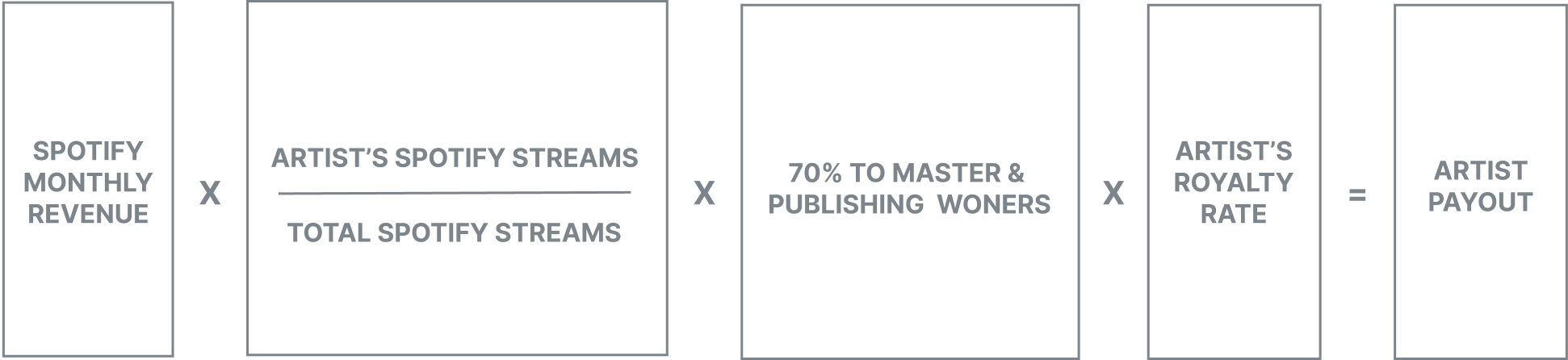


What causes a profound distortion and consequent inequities in the levels of remuneration resulting from this system of calculation is that while royalties are determined on the basis of the number of listens to each song, the bulk of streaming services’ revenues are derived not from listening but from subscriptions.
In fact, in services that adopt the pay-per-stream model for calculating royalties, the artist with the largest number of listens receives a larger percentage of revenue; while this seems like a fair and meritocratic concept, it is subject to a distortion, which arises from the fact that when a user pays the monthly subscription, the price remains the same, regardless of how many songs he or she listens to and for how many times.
Example
Let “A” be any user who subscribes to a monthly Spotify subscription and whose favorite band is a little-known rock band.
User “A” pays the monthly subscription to the platform, but in the relevant month he listens to a song by his favorite band only once.
Starting from the total subscription fee of about 10$, there is no doubt that 3$ (or 30% percent) goes to Spotify; A’s favorite band, however, is only entitled to roughly 0.007$ (which corresponds to the current average rate per single stream reported by Spotify).
As for the remaining portion of the “A” subscription, it will go toward determining the income of more established artists with higher listening levels.
Based on this model therefore, revenues for artists and rights holders involve thousands of daily micro-transactions that collectively result in remuneration levels considered inadequate by the music industry.
average rates of remuneration per listen paid by major streaming services to record companies and differentiated by platform funding formula are reported.


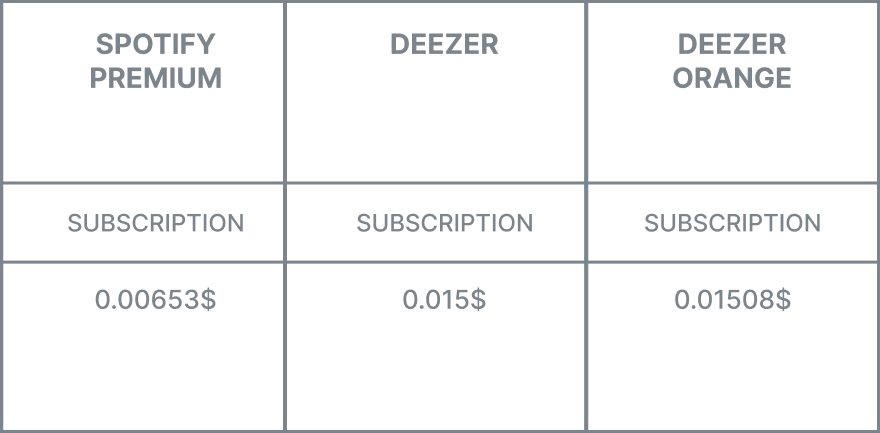
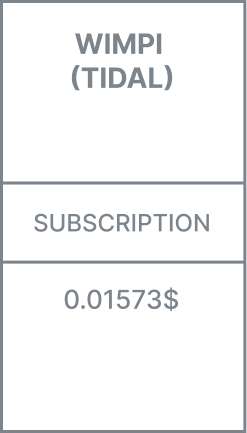
When you consider that to get the minimum monthly salary conceived in the United States, which as of 2017 was 1472$, an artist’s song must be listened to about 210 thousand times on Spotify and about 1.4 million times on YouTube.
What is more, these calculations do not reflect the real conditions of remuneration, since they are based on the assumptions that the artist holds the rights to the recording and the rights to the composition at the same time, and that he or she does not have any record company or intermediary retaining percentages.
In addition to remuneration levels, there are other issues that cause perplexity and criticism in the artisanal community.
Lack of transparency and absence of information regarding their listening and money flow data. In fact, in order to acquire song catalogs to offer on the platforms, streaming services such as Spotify negotiate licensing terms with record companies through confidentiality agreements that give artists no say and deny any transparency about the terms under which licenses are transferred, making it difficult for artists and songwriters to determine whether or not their rights are being effectively managed.
THE BLOCKCHAIN
The blockchain can be defined as a structure consisting of a data storage system based on blocks concatenated together.
They form a linear, chronological chain (hence the literal translation “chain of blocks”).
Each block contains information about transactions whose validation is entrusted to a consensus mechanism distributed across all nodes in the network.
It presents itself as an alternative to centralized databases, making it possible to manage data without the need for a central authority or intermediaries (such as a bank, government or enterprise agency).
Data once entered into the registry are immutable and unchangeable.
Any changes are added in a new block.
In fact, depending on the level of control, systems are divided into centralized, decentralized and distributed.
- In centralized systems, the transaction log is kept, managed and updated by a single centralized structure, authority or system.
- In decentralized systems, the presence of a single central structure is eliminated and control is scattered across several satellites, while maintaining common governance at the central level.
What is indisputable is that blockchain, by relying on certain fundamental principles such as decentralization, transparency, security, immutability and consensus, has not only brought about a new concept of trust among the participating members of a network, but can also take on important social and political value.
The core principles underpinning the operation of a blockchain are:
- Decentralizzazion
- In the blockchain there is no central system for the management, control and validation of transactions, and the information is not contained entirely in a single the transaction log is distributed in a network of chronologically replicated databases, synchronized across the Internet and visible to all within the participants’ network.
- Transparency:
- This feature is ensured by the fact that the blockchain is an open system that allows all its participants to access any information and transactions at any time, the entire history of which is certified, and by the control of the ledger through consensus mechanisms; in a true blockchain, each individual node in the network must always have the ability to verify everything on its own, without having to rely on information it must have from third parties.
- Security:
- A first feature of the blockchain that ensures its security lies in its peer-to-peer distributed ledger architecture.The fact that each participant has a copy of the data that are distributed over several replicated databases goes a long way to limiting the risks given by errors or changes on the data and makes the blockchain and the information inviolable and difficult to attack, because to do so would require tracking down all the computers and servers in the network scattered around the world and modifying or manipulating it in each of them, an operation of considerable difficulty. The security of data and transactions is also ensured by the use of encryption. The privacy of network members is also guaranteed, since no names are displayed, but alphanumeric codes not directly traceable to the identity of the owner.
- Immutability:
- Data management in the blockchain are immutable and provide records of events that cannot be changed, that is, without the ability to delete or modify existing data.
- Consent:
- The entry of new data into the blocks and any changes can be made only with the consent of all participants in the network. that is, without the possibility of deleting or changing existing data.


Blockchain and its principles:
The nodes consist of the servers or computers of each participant, scattered all over the world and in each of which there is an exact copy of the data record.
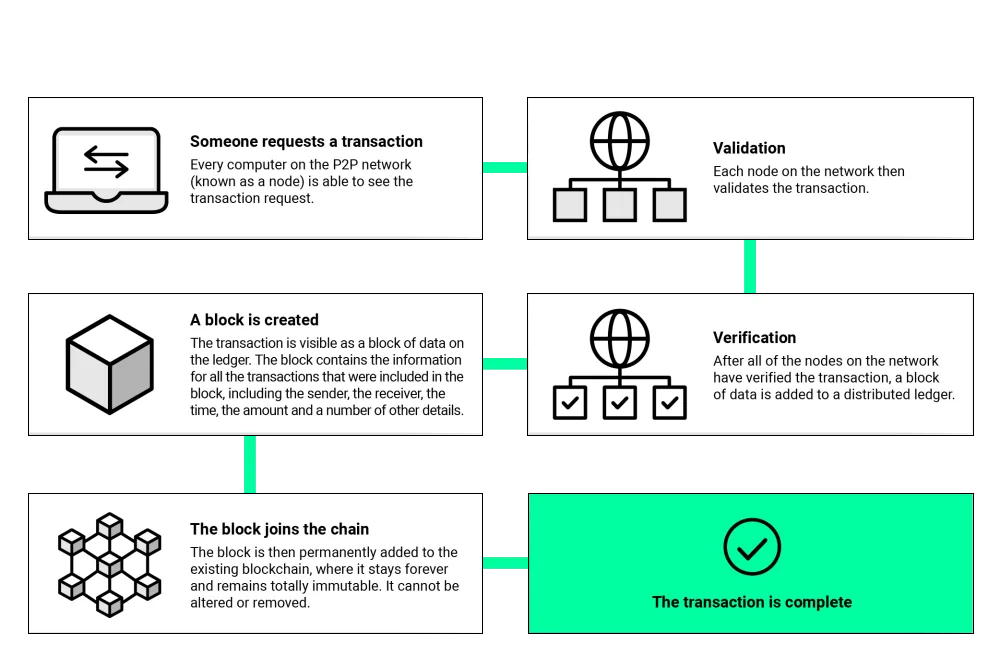
Each transaction, before it is completed and recorded, must be validated and confirmed by all nodes.
The transaction consists of the data subject to the exchange that occurred between two participants in the network The components of the transaction
The authenticity and trustworthiness of each transaction is guaranteed by the use of a private key, which each member of the blockchain possesses, that is unique, secret and uniquely linked to individual participants. This key, through cryptography, generates a signature that cannot be copied or reused in other transactions that is sent to all the nodes scattered around the world that act as validators,
There are many types of transactions that can be handled with the blockchain: one example is payments and money transfer, as in the case of Bitcoin, but there can also be transactions related to the exchange of other goods or services or information related to contracting.
Blocks are groupings of sets of transactions; joining multiple blocks together in chronological order based on the date on which the transactions occurred gives rise to the blockchain.
The ledger is the public ledger that transparently and immutably stores and guards the history of all transactions that occurred between network participants, a concatenated block structure joined through cryptographic functions and through hashes
Hash is a cryptographic function that consists of a mathematical algorithm that converts a string containing a variable number of characters of any size into one of specified length, that is, with a fixed amount of characters.
This cryptographic functionpermits the unique identification of each piece of data and each transaction block, used both for security management and for fast and accurate verification of data integrity, regardless of its complexity.
to validate and add a block, a complex mathematical problem must be solved that requires a substantial amount of effort, especially in terms of processing power and capacity.
Miners, who are precisely the members or nodes of the network with high levels of computational power, compete to solve mathematical problems and validate transactions.
The miner receives remuneration with a unit of value that depends on the type of blockchain
There are mainly three types of blockchain.
They are distinguished into:
- public (or permissionless) blockchain, requiring no authorization to access the network, execute transactions and participate in the verification and creation of a new block.
- Private blockchains, in contrast, are networks in which records are shared and validated by a predefined group of nodes. Accessing the network and reading data requires permission from a central organization, which is deemed by users as highly trusted.
- permissioned blockchain, these are hybrid solutions between public and private networks in that they incorporate many participants but the main nodes are initially selected . What distinguishes a private blockchain from a permissioned one is that in the latter there are different levels of access and, consequently, required permissions.
The most famous blockchains are undoubtedly Bitcoin and Ethereum, both of which belong to the category of public networks.
Bitcoin
currency that exists only at the digital level, but it is also the term that identifies the peerto-peer network that supports this new system of payment and value transfer.
Bitcoin is not associated with any state or government and there is, therefore, no centralized authority in charge of its issuance or regulatory control.
what allows bitcoin to exist is the presence of a network of people and the use of cryptography, they can be exchanged between various computers scattered around the world by making transactions that are validated and recorded in a huge distributed public ledger, the blockchain.
Ethereum
Ethereum and Bitcoin are two separate projects
Ethereum while also handling transactions in its own digital currency is known for its main focus on developing and managing “Smart Contracts.”
Smart Contracts, like blockchain, also enjoy total autonomy from any intermediary and security, guaranteed by the use of cryptography.
Underlying the operation of the blockchain and its security is the use of cryptography.
Every transaction that takes place through the network is encrypted in order to certify all data.
a system that uses a pair of keys that are linked by a mathematical function that ensures that a message encrypted with one key can only be decrypted by the other.
Based on this system therefore, each participant has two keys:
- a public one, which is accessible to all and is essential for one’s identification,
- a private one, which is secret and is used to authenticate and encrypt transaction messages.
At the point when two parties want to make an exchange of digital assets of any nature, a transaction is created containing information about the assets.
The transaction starts with a digital signature, which certifies the identity of the person making the transactions, and the public keys of the participants, and then the transaction becomes part of a transaction block that is transmitted to all the nodes in the network that are responsible for verifying and approving the correctness of the information contained.
In order for a block to be checked and validated, a complex cryptographic mathematical puzzle must be solved, which requires a considerable amount of energy expenditure.
Once the block is verified and validated, it becomes part of the blockchain by adding to the chain of other blocks and becoming transparent and accessible to all network participants.
Henceforth, the transaction data that is noted in the distributed register is immutable and unchangeable.
THE BLOCKCHIAN & MUSIC
The combination of platforms based on blockchain protocols and DLT technologies and the use of Smart Contracts can enable the construction of an entirely new music ecosystem with innovative features.
The disintermediation enabled by the blockchain would allow them to choose the pricing and terms of use of their musical creations and to have absolute control over the data related to the enjoyment of their tracks, information useful for attracting the right sponsors, organizing tours and concerts, and planning collaborations.
Artists can thus stand as their own entrepreneurs, no longer having to depend completely on a label or other market intermediaries.
The relationship with end consumers will also have new features, allowing artists a more direct relationship with their fan base and audience.
Royalty payment processes would undergo a significant revolution, through the use of smart contracts that directly and immediately execute the division and distribution of proceeds among all those who contributed to the creation of a piece of music.
Blockchain can provide a three-pronged innovative solution:
- The inconsistency and incompleteness of metadata.
- The complexity of licensing systems.
- The lack of transparency and efficiency in royalty payment processes.
Blockchain Technology can be introduced into all sectors.
How?
- The introduction of decentralized infrastructure
- the need for no intermediaries
- The management of data and information on immutable records
- The implementation of automation using Smart Contracts.
Metadata is the information underlying a song or album, which includes the title, names of songwriters and producers, publishers, record company, etc…
Such information and data are essential to properly identify eremunerate all rights holders.
Record companies, streaming services and collecting societies have their own databases, based on different rules, and none of them contains all the information about each work in the music market.
It is estimated that about 25 percent of the proceeds do not reach their rightful beneficiaries.
Several attempts have been made in recent years to create a centralized database for music track metadata
One of these is the Global Repertoire Database (GRD), created in 2014 at the initiative of the European Union with the collaboration of companies such as Apple, Amazon and Google and with the involvement of several publishers and CMOs.
The GRD project, however, which aimed to create a single shared and standardized music database with a comprehensive view of the rights ownership of each musical work, has failed due to the lack of financial support from collecting societies
Through Blockchain technologies
Information would be updated instantaneously and automatically and made visible to all network users, distributed network for the management of metadata and music copyright ownership information in a single decentralized database.
The use of encryption would ensure the unique identification of each song, of which they would be recognized and certified, where they are tracked through a registry that contains the history and certification information of each piece of music.
which would be basically characterized by two components:
- Decentralized repositories: which contain metadata about the creation of music tracks and which are replicated, i.e., available in exact copies, in different places through the Internet. They are open access insofar as anyone can read the information contained here, but only authors, artists or those with permission can write and generate new files containing the metadata of their musical works.
- A metadata registry: where creators can record information about their works. Access to such a registry must include a globally unique identifier that allows anyone to trace the identifier back to a copy of the complete metadata in networked repositories.
The registry has the function of certifying each unit of metadata or each short summary thereof. In addition, the uniqueness with which information is recorded also allows different versions of the same tracks, on which, moreover, there may be different contributions and owners and which, therefore, should be handled separately.
Through the use of distributed networks, cryptography, and public key digital signature systems, an efficient and secure data management system is created that guarantees and ensures the authenticity, consistency, and global replication of the same metadata information for each song, with which files with their respective music content can then also be associated.
The implementation of blockchain in the music industry has the potential to revolutionize the current structure of licensing processes
Would enable completeness, correctness and verifiability in metadata and information regarding each piece of music and ensure reliability, efficiency and transparency in the licensing processes and those of remuneration of the actual beneficiaries.
Through the implementation of automation, through the use of Smart Contracts.
Rights and licenses can be treated as digital assets, whose transactions are managed, validated, and recorded in a decentralized, transparent, and verifiable manner.
It would be possible for a composer or author to use Smart Contracts to transfer licenses for their songs to other parties (such as publishers, other artists, etc.).
The composer must first record metadata about the work in the respective ledger to enable, then the Smart Contract to correctly, uniquely, and unambiguously reference the content to be licensed.
This mechanism ensures that there is accuracy in the licensing process even if there are several different versions of the same song.
In the simplest case, the Smart Contract may contain only the legal aspects and clauses related to the license agreement, to which the licensee’s digital signature is then affixed.
Therefore, when a licensee wants to license the exploitation of a piece of music content, he or she will have to use the right Smart Contract within the infrastructure that manages the licensing process.
Depending, then, on the type of implementation that is made of the contracts, the licensee may be required to make an upfront payment that must be proven in order to obtain the license.

Blockchain technology has the potential to save the creative industries, including the music industry, by revolutionizing rights management and royalty distribution through an ecosystem that processes and exchanges data and assets in a decentralized manner.
streaming and digital content enjoyment generate millions of micro-transactions per day
The introduction of blockchain and, in particular, the application of Smart Contracts can be particularly revolutionary for the music industry, insofar as they can support the automatic management of royalty payments to artists and other owners who claim shares in the revenue from each song.
Smart Contracts, in fact, can make possible the division of revenue percentages and the distribution of cash flows automatically among rights holders and at a time almost simultaneous with the listening, downloading, or purchase of the music content.
WEB 3 & SMART CONTRACTS
Before moving on to Web3, let’s go back to the timeline and review WEB 1.0 and Web 2.0.
Web 1.0
Popular from the 1990s to the mid-2000s, it is a one-dimensional Internet. At that time, Web sites had only one function, that of displaying a list of information. So, you can read it.
It is not possible to post, share and interact with other people because it has not yet been thought of.
It is the era of reading.
Web 2.0
Widespread from the mid-2000s to the late 2010s, is a two-dimensional Internet.
Example websites are Facebook, Instagram, Snapchat with more functions. In addition to reading information from their platform, you can also post your content so that other people or users can also read yours and vice versa.
It is the era of reading and writing.
Web 3.0
Web3 refers to a decentralized online ecosystem based on blockchain.
Web3-based platforms and apps will not be owned by a central server.
But from users who will earn their share of ownership by helping to develop and maintain such services.
Web3 is the era of reading,writing, and owning.
All this is made possible thanks to:
- Blockchain network
As discussed earlier, blockchain technology is the foundation on which Web3 is built. Using a blockchain network, data is decentralized so that users own their data and can exchange it without losing ownership. There is no risk of data breaches and there are no intermediaries involved. It also allows users to securely access various services.
In addition, blockchain is also essential for cryptocurrency, which is another important element of Web3. Non-fungible tokens (NFTs), which are used to power transactions in Web3, are also based on blockchain technology.
- Artificial intelligence
Although Web 2.0 has its share of artificial intelligence (AI), it is still mainly controlled by large technology companies. In Web 3.0, we will see AI used to support decentralization
- Augmented reality/virtual reality (AR/VR)
AR/VR is another important component of Web3 because this technology will form the basis of the metaverse, which in turn is important for the future of Web3. We will talk more about the metaverse at the end of the article.
- Without permission
In Web3, users do not need specific permissions to use the Internet. Users will be able to access specific services without sharing their personal information. There is no need to compromise on privacy or share other data.
- Safe
Web 3.0 is much more secure than Web 2.0 because decentralization makes it difficult for hackers to target specific databases.
The smart contract we can infer, concretely, is software based on blockchain technology.
They define rules and conditions to be met by tracing, digitally, all the characteristics of a traditional contract.
To clarify the operation of these application software, it is necessary to distinguish all the stages involved in the emergence of these digital bonds.
Fassi
The first step is the agreement: this involves entering into the contract and signing the clauses that bind the counterparts
They are then translated and recorded into a smart contract that is entered and transcribed into the blockchain, which will perform a check on the availability of the funds of the user registering the digital agreement.
identified by a hash code, the contract becomes part of a blockchain block that guarantees its maintenance,
Within the block, validation by blockchain participants takes place.
After being validated, obtaining consent from the nodes, the created block is added to the chain by being time-stamped
The operation at this point turns out to be public and visible within the platform.
as the last step, there is the execution of the contract, which occurs automatically once the input is received.
example
A smart contract could be roughly likened to the activity performed by any vending machine .
An agreement arises between a buyer and distributor in which the distributor agrees to perform its task only in the event of input from the external party.
Of course, the issue is not so simple.
The “code” prefigures a set of instructions with descriptions of conditions upon the occurrence of which specific actions also defined in the code are automatically triggered.
Carried out by a computer that follows the “clauses” preset and decided by the parties, without the possibility of modification or interruption, with the main ultimate purpose of producing legal effects between the contracting parties.
his vanatges:
- Efficiency and speed of execution: by entrusting execution to software and not to the technical time of procedural steps related to the bureaucratic apparatus, these agreements can be executed in real time, speeding up relations between the parties.
- Reduced costs: standardized smart contracts have the ability to escape commercial negotiations by merging them within the agreement, without the need for a third party regulator, thus avoiding any transaction or administrative costs. In addition, automatic enforcement, and thus the certainty that fulfillment occurs as agreed through the consensus mechanism, means that the costs of performance monitoring and, consequently, the number of disputes that may arise are reduced.
- Accuracy: By not depending on human intervention and operating transparently, the execution of smart contracts is less prone to errors and the risk of manipulation. 10 IV. Clarity: the ambiguity of natural language and, as a result, the misinterpretation of traditional contracts can be the cause of contentions and disputes or can be used by the party to free itself from contractual conditions that it no longer wants to comply with. This is not the case with regard to smart contracts, given and
From centralized payment systems with the concept of “trust” to a third-party guarantor, we have moved to a diametrically opposed solution with the absence of trust and total decentralization.
tokenization
This process can be described as the encapsulation of a value in an exchangeable and tradable unit of account called a token
blockchain technology thus turns out to have disruptive potential in that it allows the concept of exchangeable and quantifiable value to be extended into items such as labor, reputation, voting rights, or even copyright and property rights for creative works.
With blockchain, it is possible to “tokenize” these expressions of value in order to detect and account for them.
Digital abundance is one of the fundamental and successful properties for the Internet.
It must be pointed out, however, that while such a feature in the late-stage web has its positive values such as mass dissemination of information at a very low cost, it is equally true that it poses a problem at the time when the information must represent something of value that is unique and attributable to its “owner.”
Tokens can be divided into three main categories:
- Payment type: these are tokens that present themselves exclusively as “cryptocurrencies” and are therefore used to make payments. This type of token can be exchanged with other tokens of the same type or with “fiat” coins, but cannot be used to access services or features of any project.
Utility type: utility tokens, as can be guessed from the name, are made to provide a utility to the holder. This means that holders can use their tokens to access services or features that are offered by a DLT platform, the issuer of these tokens.
Investment type: investment tokens represent asset value such as shares 20 of real values or companies
By owning such tokens one acquires rights generally to vote on decision-making matters or rights to receive payments such as dividends or interest.
BTC and ETH cryptocurrencies can be classified as digital tokens.
They can also be said to be native tokens because they are tied to the basic functionality of the respective Bitcoin and Ethereum systems.
The Blockchain 2.0 category extends blockchain to sectors other than finance through the implementation of smart contracts.
Blockchain 2.0 technology enables the creation/management of additional tokens
These tokens therefore exist and are managed within a contract (smart contract)
as an independent database, with separate management from native tokens.
A distinctive property of native tokens and ERC-20 tokens is their fungibility, i.e., interchangeability
“Non-fungible tokens” can also be created, and to this possibility Crypto Art owes its birth.
A non-fungible token is a set of data, uniquely assigned to a Blockchain address
The token constitutes a unique digital resource
Blockchain ensures that non-fungible tokens cannot be duplicated.
ERC-721
ERC-721 is an Ethereum standard that allows you to implement an API (application programming interface) for NFT, then create an NFT.
Following ERC-20 and ERC-721, Ethereum has designed and developed the new ERC-1155 standard, which enables the creation of an intelligent contract interface that can represent and control both fungible and non-fungible tokens
ERC stands for Ethereum Request for Comments, a document with which an improvement process begins and formally concludes with an EIP (Ethereum Improvement Proposal), allowing the system to be used in the most efficient and secure way.
The ERC-20 standard, introduced a few months after Ethereum’s genesis block, allows for the optimal creation and management of fungible tokens other than ETH.
The smart contract includes six core functions and three optional functions:
functions:
- TotalSupply (total amount of tokens entered into the system).
- BalanceOf (token balance of a specific address).
- Transfer (sending of tokens) – transferFrom (withdrawal of tokens).
- Approve (permission to draw).
- Allowance (limit imposed on withdrawal).
- Name (name of created token, optional).
- Symbol (symbol of the token created, optional).
- Decimal (the smallest transferable amount, optional).
The ERC-721 standard, which creates and manages non-fungible tokens (NFTs), adds other functions to the functions related to the ERC-20 standard. These additional functions are used to define the uniqueness of the token and define/manage the ownership title.
The ERC-721 standard:
- tokenMetadata (identifies the URL address, uniform resource locator, of the digital object underlying the NFT property title)
- ownerOf (provides the owner address of a given NFT)
- takeOwnership (transfers ownership of an NFT)
- takeOwnershipByIndex (is used in the case of NFTs with edition number ≠1, to track individual editions)
Management is done with reference to metadata corresponding to file storage, which is generally done by using the InterPlanetary File System (IPFS) protocol for storing and sharing data in a distributed peer-to-peer system.
SOUNDX PROJECT
Soundx Introduction
La nostra società ha raggiunto o sta raggiungendo molti traguardi.
uguaglianza di genere e razziale, connettività globale, energia rinnovabile.
A molti può sembrare una cosa banale
Oggi un musicista non ha ancora la possibilità di essere indipendente, artisticamente ed economicamente parlando.

Oggi un artista deve ancora passare attraverso molteplici intermediari per far sì che la sua passione diventi un lavoro.
Noi di SOUNDX vi diamo il benvenuto nel futuro.
Users
ci saranno tre tipi di utenti che potranno accedere alla piattaforma SOUNDX

Subscriber

Buyer

Owner
Tre diversi tipi di possibilità:
subscriber
Su Soundx, non ci saranno pubblicità, né abbonamenti diversi l’uno dall’altro.
ci sarà un abbonamento di soli 19,99 dollari.
questo abbonamento consente di accedere alla piattaforma e di avere :
- Artistic round
Ogni settimana, l’intelligenza artificiale di SOUNDX organizzerà l’ascolto degli artisti da parte degli abbonati in base a una categoria, questa categoria sarà scelta dalla I.A stessa basandosi su un calcolo causale.
Example
se I.A. vi avverte che è stata selezionata per voi la lettera “A”, potrete ascoltare solo musica prodotta da artisti il cui nome inizia con la lettera “A”.
se I.A. vi avverte che è stata selezionata per voi il mese “Aprile”, potrete ascoltare solo musica prodotta da artisti il cui mese di nascita inizia è “Aprile”.
- Podcast
- Playlist
buyer
Soundx vuole essere il futuro
Vogliamo riportare la musica agli albori dei tempi passati, quando un album rimaneva in classifica anche per un anno.
Quando l’unico modo per ascoltare il proprio artista preferito era quello di acquistare il suo CD.
L’artista, quando si iscrive alla piattaforma Soundx, accetta di pubblicare quel determinato album/traccia musicale solo sulla piattaforma Soundx.
Così facendo, l’utente “acquirente” sarà l’unico a possedere una copia virtuale dell’album dell’artista.
l’acquirente non pagherà un abbonamento, ma per ascoltare la musica dovrà farlo:
- Acquistando l’album o il brano musicale.
Per creare una vera comunità abbiamo deciso che:
- Gli album potranno essere scambiati con altri utenti, come avveniva in passato.

owner
Grazie alla tecnologia blockchain e ai contratti intelligenti.
Ora gli utenti potranno acquistare un brano musicale e disporre di tutti i diritti commerciali su di esso.
Il proprietario potrà:
- Diventare proprietario di un brano musicale/album di un artista e riceverne tutti i diritti commerciali e guadagni
- Diventare proprietario di una parte di un brano/album e ricevere entrate stabilite dalla percentuale concordata
il possessore può :
- Fare un’offerta all’artista o al gruppo artistico per la proprietà dell’intero brano/album, se quest’ultima viene accettata
- Tutti i guadagni derivanti dagli abbonamenti e dagli acquirenti andrà a lui
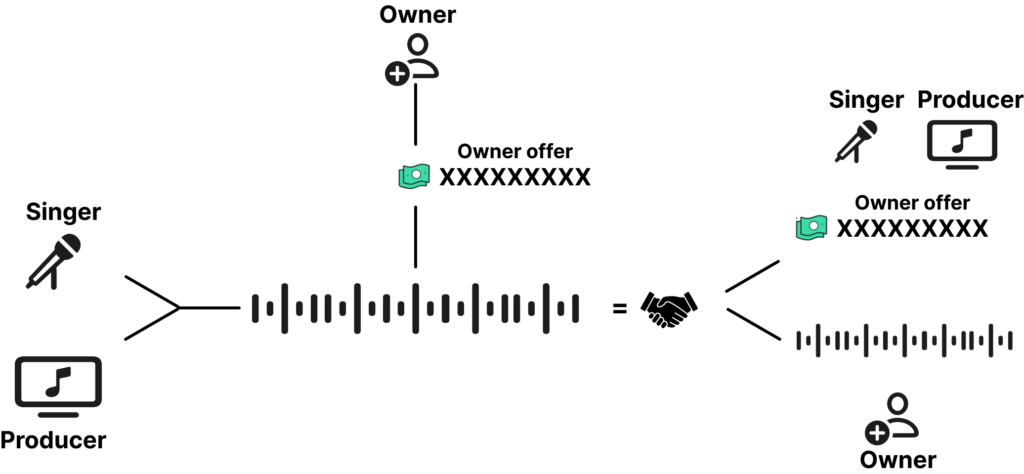
- Fare un’offerta all’artista o al gruppo artistico per la proprietà di una parte del brano/album, se quest’ultima viene accettata
- Una percentuale dei guadagni derivanti dagli abbonamenti e dagli acquirenti andrà a lui
Artist
Siamo arrivati al punto, grazie allo streaming, in cui la musica è diventata un sottofondo.
Si è passati da un’economia di possesso a un’economia di accesso.
L’artista quando pubblica il suo brano su SOUNDX.


Accetterà con firma elettronica di poter pubblicare il brano/album da lui creato solo sulla nostra piattaforma e in nessun’altra.
- Non prendiamo i diritti della traccia musicale o dell’album
- L’artista non è tenuto a pubblicare ogni brano creato sulla nostra piattaforma.
Chiariamo che se un artista decide di pubblicare un brano o un album sulla piattaforma Soundx, quel brano o quell’album deve essere presente solo sulla piattaforma Soundx.
Artist account
All’entrata della piattaforma Soundx, successivamente alla sezione artista, dovrai scegliere il tuo ruolo artistico

SINGER
Lorem ipsum dolor sit amet, consectetur adipiscing elit. Ut elit tellus, luctus nec ullamcorper mattis, pulvinar dapibus leo.
PRODUCER
Lorem ipsum dolor sit amet, consectetur adipiscing elit. Ut elit tellus, luctus nec ullamcorper mattis, pulvinar dapibus leo.
ARRANGIATORE
Lorem ipsum dolor sit amet, consectetur adipiscing elit. Ut elit tellus, luctus nec ullamcorper mattis, pulvinar dapibus leo.

GHOSTWRITER
Lorem ipsum dolor sit amet, consectetur adipiscing elit. Ut elit tellus, luctus nec ullamcorper mattis, pulvinar dapibus leo.
INVESTITOR
Lorem ipsum dolor sit amet, consectetur adipiscing elit. Ut elit tellus, luctus nec ullamcorper mattis, pulvinar dapibus leo.

GRAFICO
Lorem ipsum dolor sit amet, consectetur adipiscing elit. Ut elit tellus, luctus nec ullamcorper mattis, pulvinar dapibus leo.

STUDIO DI REGISTRAZIONE
Lorem ipsum dolor sit amet, consectetur adipiscing elit. Ut elit tellus, luctus nec ullamcorper mattis, pulvinar dapibus leo.

PROMOTORE
Lorem ipsum dolor sit amet, consectetur adipiscing elit. Ut elit tellus, luctus nec ullamcorper mattis, pulvinar dapibus leo.

Web content video editor
Lorem ipsum dolor sit amet, consectetur adipiscing elit. Ut elit tellus, luctus nec ullamcorper mattis, pulvinar dapibus leo.

Streaming platform data analyst
Lorem ipsum dolor sit amet, consectetur adipiscing elit. Ut elit tellus, luctus nec ullamcorper mattis, pulvinar dapibus leo.

OFFICE
Lorem ipsum dolor sit amet, consectetur adipiscing elit. Ut elit tellus, luctus nec ullamcorper mattis, pulvinar dapibus leo.

BRAND
Lorem ipsum dolor sit amet, consectetur adipiscing elit. Ut elit tellus, luctus nec ullamcorper mattis, pulvinar dapibus leo.
Division and derivation of earnings from the song or album
Le divisioni dei guadagni dipenderanno:
- Dal numero di account collegati alla traccia/album
- L’introito percentuale per ogni account collegato alla traccia
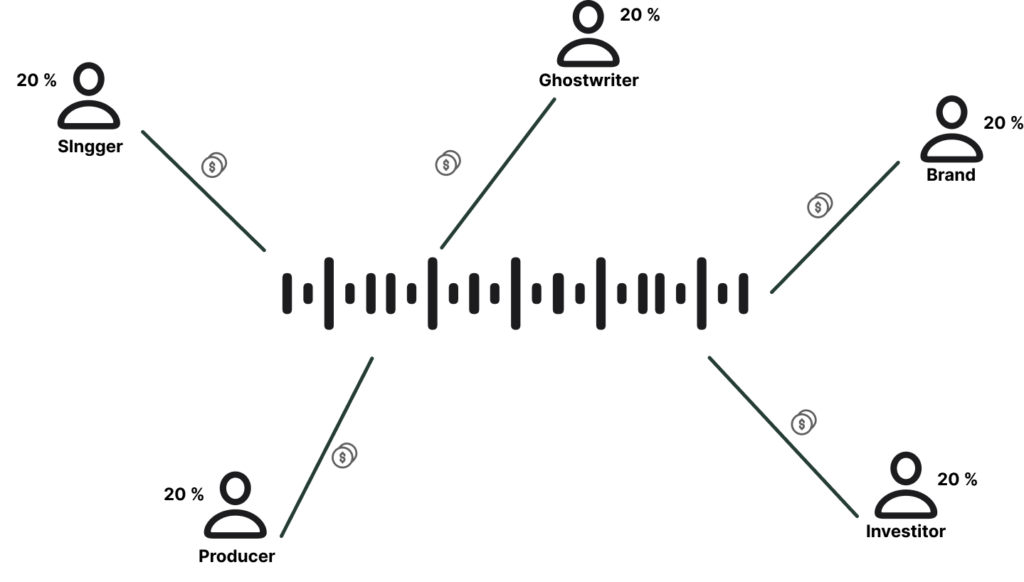
I guadagni derivano:
- dall’acquisto della traccia tramite gli account buyer
- Una volta che il buyer ha acquistato la canzone, il guadagno va diviso per gli account collegati alla traccia
- dall’ascolto degli abbonati
- Una volta che l’utente con l’abbonato ha ascoltato la canzone, viene calcolato alla fine del mese, quanto dell’abbonamento dovrà andare alla traccia
- dall’acquisto totale o parziale della traccia/album da parte dell’owner
- Totale: l’offerta accettata dal gruppo dei partecipanti porta alla divisione del guadagno per tutti gli account collegati alla traccia/l’album ma alla perdita totale dei diritti commerciali da parte dei “fondatori” della canzone
- Parziale: l’offerta accettata dal gruppo dei partecipanti porta alla divisione del guadagno per tutti gli account collegati alla traccia/l’album ma alla perdita e ad un restringimento percentuale dai guadagni da parte della traccia/album
Pensione
quando entri su Soundx potrai scegliere l’opzione pensione

Tramite la sezione pensione, potrai decidere in percentuale, quanto dovrà entrare ogni mese nel tuo portafoglio pensione.
potrai scegliere dopo quanto il tuo fondo pensione inizierà a restituirti il denaro.
1 ANNO
3 ANNI
5 ANNI
9 ANNI
alla fine dell’arco dei tempo scelto i soldi verranno restituiti ina base
- ogni quanto tempo
- ogni quanto in percentuale


Cosi facendo si avrà come uno stipendio mensile, una mancia dalla nonna, però data da noi di SOUNDX
questo lo facciamo per un motivo preciso, causato dall’HYPE
vogliamo far sì che l’artista faccia della sua passione un lavoro, conoscendo l’essere umano la sua goliardia, non sa gestire i propri soldi, per questo diamo questa opportuni opzionale
Sicurezza I.A.
per assicurare l’artista che la sua creazione artistica rimanga solo all’interno della piattaforma
I nostri developer creeranno una bot security di controllo
Per monitorare tramite i database dei Player centralizzati, se corrispondono file già esistenti nella piattaforma Soundx
In caso di riscontro positivo scattano le fasi di:

- Segnalazione compulsiva al piattaforma
- Segnalazione allo stato madre dell’account
- Segnalazione all’organo europeo sul copyright

Piattaforme controllate:
Telegram
Youtube
Spotify
Soundcloud
Other
payment method
Copia l’indirizzo del tuo portafoglio nell’estensione del browser del tuo portafoglio e utilizza lo stesso indirizzo per inviare criptovalute dal tuo scambio o da un altro portafoglio. Potresti anche essere in grado di acquistare criptovaluta direttamente tramite l’estensione del tuo portafoglio. Segui le indicazioni per il tuo specifico fornitore di portafogli
A seconda di dove vivi, potresti anche essere in grado di acquistare criptovaluta utilizzando una carta .
Pagamenti accettati:

ETH / WETH

SOLANA

USDC

DAI
Pubblicazione e deposito
ci occuperemo noi della pubblicazione e il deposito
PuBBLICAZIONE
Soundx vuole diventare una piattaforma dove un artista può esprimersi al massimo
ma questo non vuole ire che su Soundx sarà possibile pubblicare tutto quello che si vuole
Ci saranno dei livelli qualitativi da tenere.
Le fasi saranno:

Inserimento della traccia/album all’interno della piattaforma
Accettazione da parte del gruppo creatore della traccia, che quest’ultiam sarà pubblicata solo nella piattafroma soundx

Controllo da parte della I.A.
Controllo da parte del team di Soundx

Pubblicazione su Soundx
Artist
Siamo arrivati al punto, grazie allo streaming, in cui la musica è diventata un sottofondo.
Si è passati da un’economia di possesso a un’economia di accesso.
L’artista quando pubblica il suo brano su SOUNDX.
Accetterà con firma elettronica di poter pubblicare il brano/album da lui creato solo sulla nostra piattaforma e in nessun’altra.
- Non prendiamo i diritti della traccia musicale o dell’album
- L’artista non è tenuto a pubblicare ogni brano creato sulla nostra piattaforma.
Chiariamo che se un artista decide di pubblicare un brano o un album sulla piattaforma Soundx, quel brano o quell’album deve essere presente solo sulla piattaforma Soundx.
Artist account
All’entrata della piattaforma Soundx, successivamente alla sezione artista, dovrai scegliere il tuo ruolo artistico
SINGER
Lorem ipsum dolor sit amet, consectetur adipiscing elit. Ut elit tellus, luctus nec ullamcorper mattis, pulvinar dapibus leo.
PRODUCER
Lorem ipsum dolor sit amet, consectetur adipiscing elit. Ut elit tellus, luctus nec ullamcorper mattis, pulvinar dapibus leo.
ARRANGIATORE
Lorem ipsum dolor sit amet, consectetur adipiscing elit. Ut elit tellus, luctus nec ullamcorper mattis, pulvinar dapibus leo.
GHOSTWRITER
Lorem ipsum dolor sit amet, consectetur adipiscing elit. Ut elit tellus, luctus nec ullamcorper mattis, pulvinar dapibus leo.
INVESTITOR
Lorem ipsum dolor sit amet, consectetur adipiscing elit. Ut elit tellus, luctus nec ullamcorper mattis, pulvinar dapibus leo.
GRAFICO
Lorem ipsum dolor sit amet, consectetur adipiscing elit. Ut elit tellus, luctus nec ullamcorper mattis, pulvinar dapibus leo.
STUDIO DI REGISTRAZIONE
Lorem ipsum dolor sit amet, consectetur adipiscing elit. Ut elit tellus, luctus nec ullamcorper mattis, pulvinar dapibus leo.
PROMOTORE
Lorem ipsum dolor sit amet, consectetur adipiscing elit. Ut elit tellus, luctus nec ullamcorper mattis, pulvinar dapibus leo.
Web content video editor
Lorem ipsum dolor sit amet, consectetur adipiscing elit. Ut elit tellus, luctus nec ullamcorper mattis, pulvinar dapibus leo.
Streaming platform data analyst
Lorem ipsum dolor sit amet, consectetur adipiscing elit. Ut elit tellus, luctus nec ullamcorper mattis, pulvinar dapibus leo.
OFFICE
Lorem ipsum dolor sit amet, consectetur adipiscing elit. Ut elit tellus, luctus nec ullamcorper mattis, pulvinar dapibus leo.
BRAND
Lorem ipsum dolor sit amet, consectetur adipiscing elit. Ut elit tellus, luctus nec ullamcorper mattis, pulvinar dapibus leo.