THE BLOCKCHAIN
The blockchain can be defined as a structure consisting of a data storage system based on blocks concatenated together.
They form a linear, chronological chain (hence the literal translation “chain of blocks”).
Each block contains information about transactions whose validation is entrusted to a consensus mechanism distributed across all nodes in the network.
It presents itself as an alternative to centralized databases, making it possible to manage data without the need for a central authority or intermediaries (such as a bank, government or enterprise agency).
Data once entered into the registry are immutable and unchangeable.
Any changes are added in a new block.
In fact, depending on the level of control, systems are divided into centralized, decentralized and distributed.
- In centralized systems, the transaction log is kept, managed and updated by a single centralized structure, authority or system.
- In decentralized systems, the presence of a single central structure is eliminated and control is scattered across several satellites, while maintaining common governance at the central level.
What is indisputable is that blockchain, by relying on certain fundamental principles such as decentralization, transparency, security, immutability and consensus, has not only brought about a new concept of trust among the participating members of a network, but can also take on important social and political value.
The core principles underpinning the operation of a blockchain are:
- Decentralizzazion
- In the blockchain there is no central system for the management, control and validation of transactions, and the information is not contained entirely in a single the transaction log is distributed in a network of chronologically replicated databases, synchronized across the Internet and visible to all within the participants’ network.
- Transparency:
- This feature is ensured by the fact that the blockchain is an open system that allows all its participants to access any information and transactions at any time, the entire history of which is certified, and by the control of the ledger through consensus mechanisms; in a true blockchain, each individual node in the network must always have the ability to verify everything on its own, without having to rely on information it must have from third parties.
- Security:
- A first feature of the blockchain that ensures its security lies in its peer-to-peer distributed ledger architecture.The fact that each participant has a copy of the data that are distributed over several replicated databases goes a long way to limiting the risks given by errors or changes on the data and makes the blockchain and the information inviolable and difficult to attack, because to do so would require tracking down all the computers and servers in the network scattered around the world and modifying or manipulating it in each of them, an operation of considerable difficulty. The security of data and transactions is also ensured by the use of encryption. The privacy of network members is also guaranteed, since no names are displayed, but alphanumeric codes not directly traceable to the identity of the owner.
- Immutability:
- Data management in the blockchain are immutable and provide records of events that cannot be changed, that is, without the ability to delete or modify existing data.
- Consent:
- The entry of new data into the blocks and any changes can be made only with the consent of all participants in the network. that is, without the possibility of deleting or changing existing data.


Blockchain and its principles:
The nodes consist of the servers or computers of each participant, scattered all over the world and in each of which there is an exact copy of the data record.
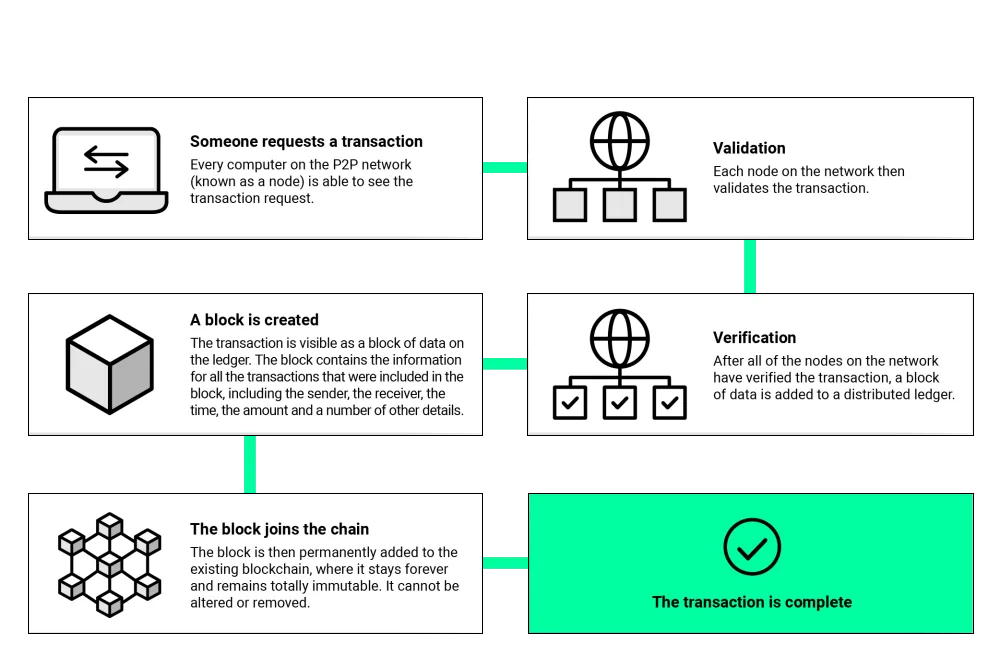
Each transaction, before it is completed and recorded, must be validated and confirmed by all nodes.
The transaction consists of the data subject to the exchange that occurred between two participants in the network The components of the transaction
The authenticity and trustworthiness of each transaction is guaranteed by the use of a private key, which each member of the blockchain possesses, that is unique, secret and uniquely linked to individual participants. This key, through cryptography, generates a signature that cannot be copied or reused in other transactions that is sent to all the nodes scattered around the world that act as validators,
There are many types of transactions that can be handled with the blockchain: one example is payments and money transfer, as in the case of Bitcoin, but there can also be transactions related to the exchange of other goods or services or information related to contracting.
Blocks are groupings of sets of transactions; joining multiple blocks together in chronological order based on the date on which the transactions occurred gives rise to the blockchain.
The ledger is the public ledger that transparently and immutably stores and guards the history of all transactions that occurred between network participants, a concatenated block structure joined through cryptographic functions and through hashes
Hash is a cryptographic function that consists of a mathematical algorithm that converts a string containing a variable number of characters of any size into one of specified length, that is, with a fixed amount of characters.
This cryptographic functionpermits the unique identification of each piece of data and each transaction block, used both for security management and for fast and accurate verification of data integrity, regardless of its complexity.
to validate and add a block, a complex mathematical problem must be solved that requires a substantial amount of effort, especially in terms of processing power and capacity.
Miners, who are precisely the members or nodes of the network with high levels of computational power, compete to solve mathematical problems and validate transactions.
The miner receives remuneration with a unit of value that depends on the type of blockchain
There are mainly three types of blockchain.
They are distinguished into:
- public (or permissionless) blockchain, requiring no authorization to access the network, execute transactions and participate in the verification and creation of a new block.
- Private blockchains, in contrast, are networks in which records are shared and validated by a predefined group of nodes. Accessing the network and reading data requires permission from a central organization, which is deemed by users as highly trusted.
- permissioned blockchain, these are hybrid solutions between public and private networks in that they incorporate many participants but the main nodes are initially selected . What distinguishes a private blockchain from a permissioned one is that in the latter there are different levels of access and, consequently, required permissions.
The most famous blockchains are undoubtedly Bitcoin and Ethereum, both of which belong to the category of public networks.
Bitcoin
currency that exists only at the digital level, but it is also the term that identifies the peerto-peer network that supports this new system of payment and value transfer.
Bitcoin is not associated with any state or government and there is, therefore, no centralized authority in charge of its issuance or regulatory control.
what allows bitcoin to exist is the presence of a network of people and the use of cryptography, they can be exchanged between various computers scattered around the world by making transactions that are validated and recorded in a huge distributed public ledger, the blockchain.
Ethereum
Ethereum and Bitcoin are two separate projects
Ethereum while also handling transactions in its own digital currency is known for its main focus on developing and managing “Smart Contracts.”
Smart Contracts, like blockchain, also enjoy total autonomy from any intermediary and security, guaranteed by the use of cryptography.
Underlying the operation of the blockchain and its security is the use of cryptography.
Every transaction that takes place through the network is encrypted in order to certify all data.
a system that uses a pair of keys that are linked by a mathematical function that ensures that a message encrypted with one key can only be decrypted by the other.
Based on this system therefore, each participant has two keys:
- a public one, which is accessible to all and is essential for one’s identification,
- a private one, which is secret and is used to authenticate and encrypt transaction messages.
At the point when two parties want to make an exchange of digital assets of any nature, a transaction is created containing information about the assets.
The transaction starts with a digital signature, which certifies the identity of the person making the transactions, and the public keys of the participants, and then the transaction becomes part of a transaction block that is transmitted to all the nodes in the network that are responsible for verifying and approving the correctness of the information contained.
In order for a block to be checked and validated, a complex cryptographic mathematical puzzle must be solved, which requires a considerable amount of energy expenditure.
Once the block is verified and validated, it becomes part of the blockchain by adding to the chain of other blocks and becoming transparent and accessible to all network participants.
Henceforth, the transaction data that is noted in the distributed register is immutable and unchangeable.